La linea
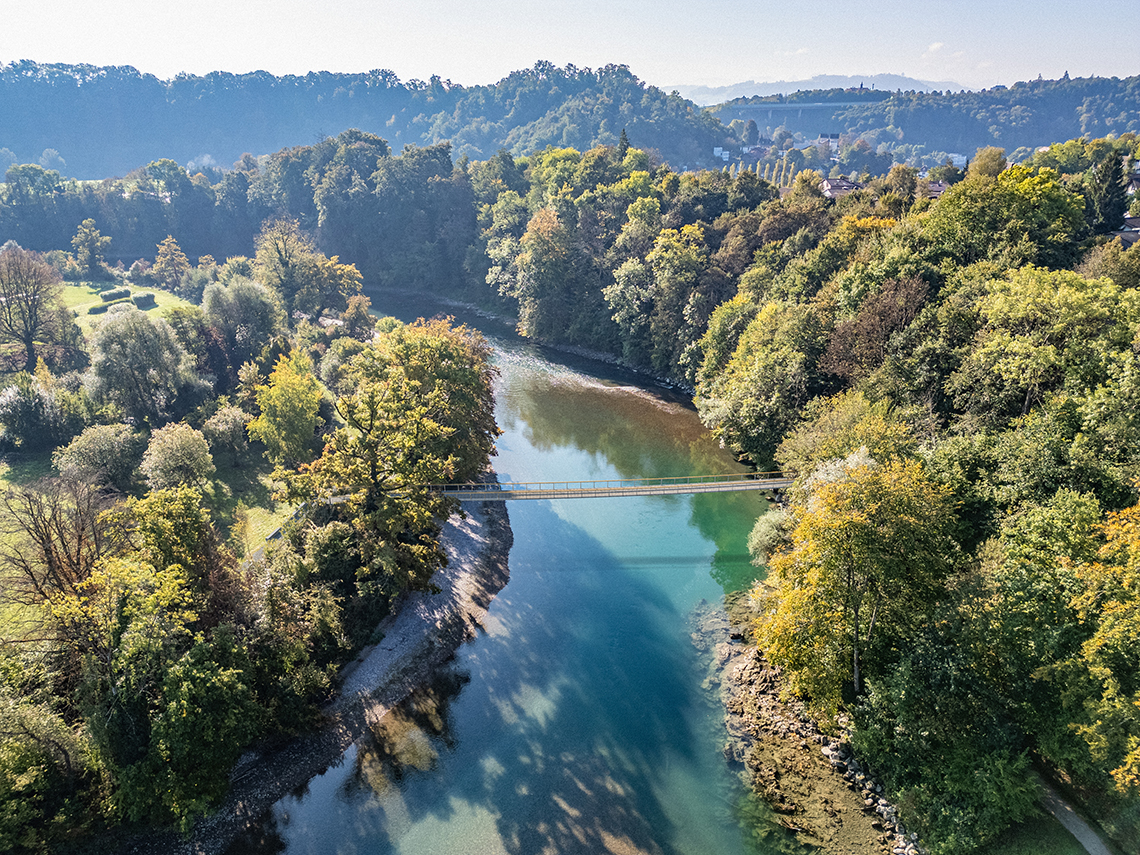
«Off to the Zehndi!» is the excursion motto of many nature lovers in the city of Bern and the surrounding region. The Zehendermätteli, idyllically located on the Enghalbinsel within the bend of the Aare, is a popular destination featuring a restaurant. To ensure year-round access to this recreational area, a pedestrian bridge across the Aare is planned to replace the existing ferry service.
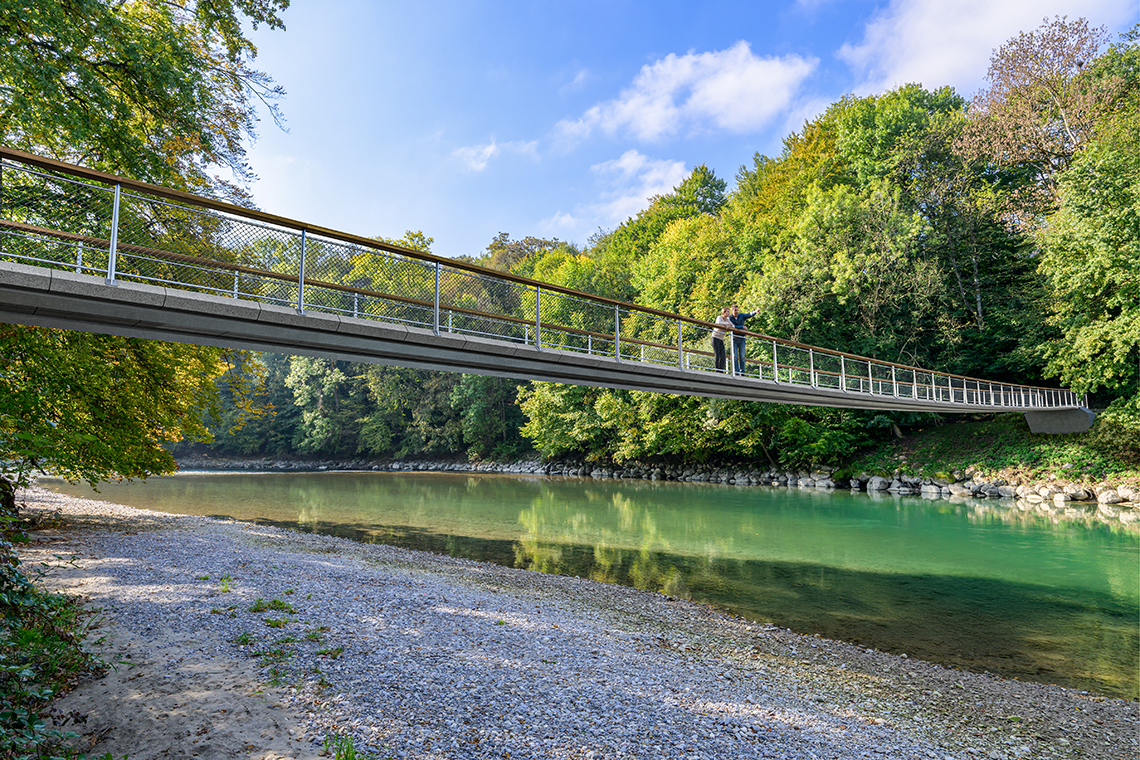
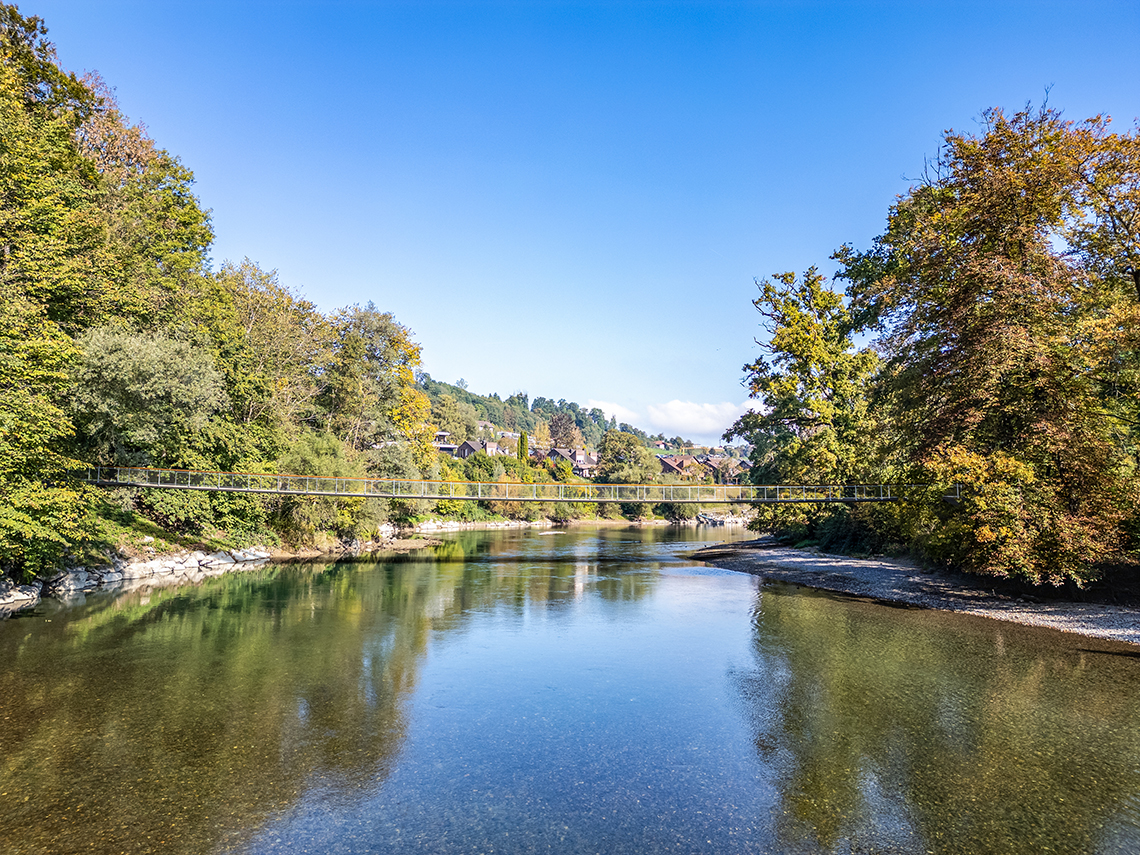
The competition entry La linea by the team LÜCHINGER MEYER PARTNER, :mlzd, and Uniola was awarded 4th place. «The design stands out for its unconventional alignment, careful detailing, and consistent materialization,.» the jury stated. The designers deliberately sought a discreet appearance that interferes as little as possible with the experience of nature. With its chosen stress-ribbon structure, the minimalist form of the bridge – resembling a liana – recalls a slightly sagging rope connecting two points across the river. The expressive gesture of the ribbon dipping toward the water further enhances the experience of nature at this site.
The structural system essentially consists of two stress ribbons anchored in abutments located on either side of the river. The ribbons are made of high-strength steel plates with a thickness of 30 mm. They behave like a rope stretched between the two riverbanks and are primarily subjected to tension.
Since no bending stresses occur and the steel has high strength, the structural elements could be reduced to a minimum cross-section, resulting in a particularly slender, lightweight, and transparent structure. To limit the span to 62 m, the abutment on the Zehendermätteli side is positioned close to the riverbed. In response to the topography, the stress ribbon follows an asymmetrical parabolic shape, with a structural depth f of 0.76 m and a slenderness ratio L/f of 81.
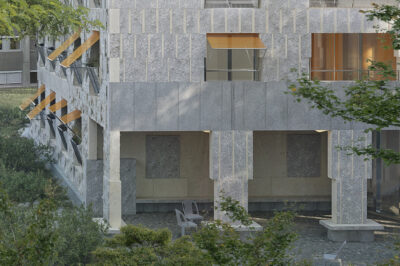
Precast concrete elements are placed on the steel ribbons to form the walking surface. For weather and corrosion protection of the steel, the joints between the precast elements are filled with mortar, and the entire surface of the pedestrian bridge is sealed with a bituminous waterproofing layer. The precast elements and abutments are made of limestone concrete C30/37 with bush-hammered surfaces, allowing the bridge to remain clearly recognizable as a constructed intervention while its coloration harmonizes with the gravel islands and riverbanks.
Interested visitors can view the submitted competition projects at a public exhibition at the Generationenhaus Bern on Friday, 27 March 2026 from 08:00 to 20:00 and Monday, 30 March 2026 from 08:00 to 17:00.
Visualizations: echt3D